
Disclosure: Lifted At Home is reader-supported. Some links on this page are affiliate links, which means we may earn a commission if you buy through them, at no extra cost to you. See our Affiliate Disclosure.
This article is general information for caregivers. It is not medical advice, and it is not a substitute for an occupational therapist, physiotherapist, doctor or a qualified installer. A grab bar that comes off the wall is more dangerous than no bar at all, because the person will trust it. If the person you support has a high fall risk, get professional advice about fixed, correctly installed rails.
Plenty of bathrooms cannot, or must not, be drilled at short notice. You may be in a rented flat, a listed house, a shower with an unknown backer behind the tile, or a family home where no one wants to cut into a freshly tiled wet wall this week. That is when caregivers start searching for “suction grab bars” and “grab bars that do not need screws.” Some of those products have a legitimate, limited job. None of them is automatically the same as a grab bar lagged into wall studs or into a solid substrate with the fittings the manufacturer specifies.
This guide explains the main no-drill options you will see in the United States and the United Kingdom, what to check before anyone leans on one, and when it is safer to wait for a proper installation. We have not lab-tested these products. We do not quote load ratings that we have not taken from a current manufacturer page, so you should read the rating on the exact model you are considering. If a listing does not state a rating and the conditions it applies to, treat that as a reason to keep looking.
The short answer
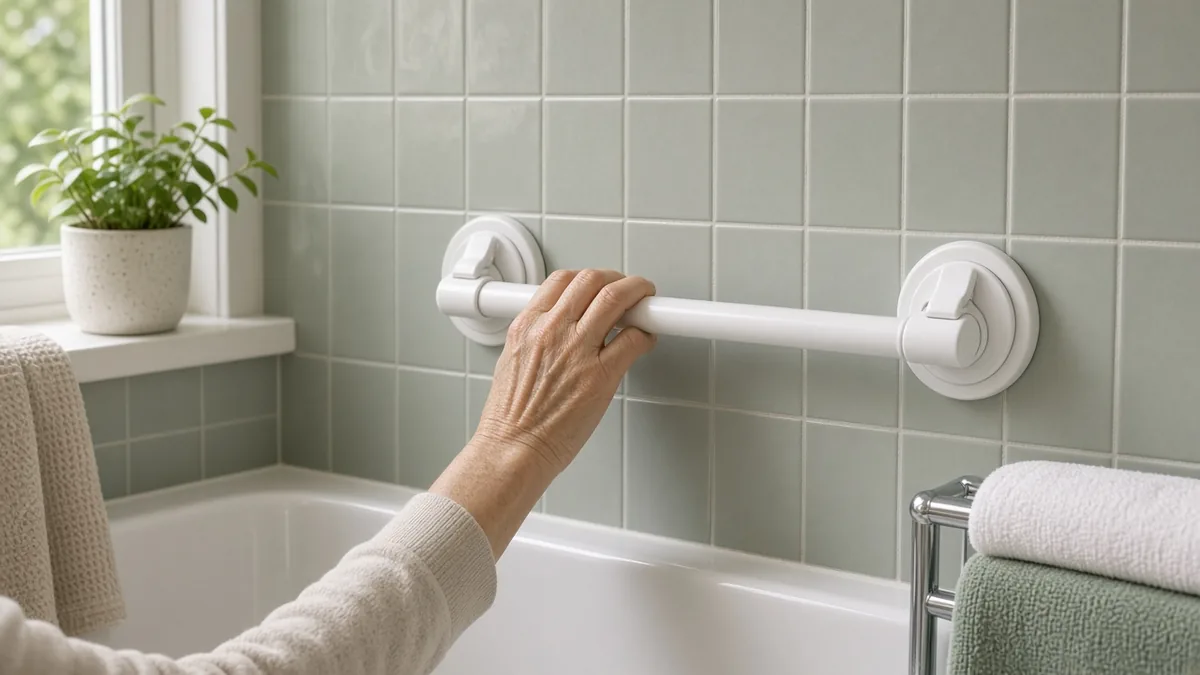
- Suction-cup grab bars can offer a light, temporary handhold on a clean, smooth, non-porous surface, such as some glass or some tiles, for balance while the person is otherwise stable. They are a poor choice as the main support for sitting down, standing up, or pulling up from a fall.
- Clamp-on or tub-mounted bars attach to the side of a bathtub rather than to the wall. They can help with getting in and out of some tubs, but only if the clamp fits that tub’s rim and the maker says the tub type is suitable. Many modern tubs have curved or thin rims that will not take a clamp safely.
- Tension or floor-to-ceiling poles (and some removable socket systems) are a different family again. They can help in some rooms if the floor and ceiling are suitable and the product is installed exactly as instructed. They are not a shower-wall grab bar.
- A screw-fixed grab bar, installed into a suitable substrate according to the manufacturer’s instructions (and, where needed, by a professional), remains the usual standard when someone will put real weight through a rail every day. If you cannot drill, you may still need a landlord’s permission, a contractor, or a different bathroom.
Why “no drill” is a trade-off, not a feature
A fixed grab bar works because the load goes into the building. A suction bar works because a seal and a vacuum (and, on some models, a locking indicator) hold a pad to the glaze. Soap film, a hairline texture on the tile, a little grout line under one pad, a change in temperature, or a slow leak of the seal can all reduce that hold. The person using it will not feel those changes in advance.
From a caregiver’s point of view, the question is not “does this stick today?” It is “will this still be there the morning someone is tired, wet and already off balance?” If the honest answer is “we would have to check it every time,” you have a product that needs a ritual, not a piece of hidden insurance.
Suction grab bars: how to use them, and how not to
US shops sell suction grab bars and “suction grab handles” from names such as Moen, Drive Medical, Vive Health, and many unbranded listings on suction grab bar at Amazon US and suction grab bar at Vive Health. In the UK, look at Homecraft, Days, Drive Devilbiss, CareCo, Complete Care Shop, Healthcare Pro / NRS and suction grab bar at Amazon UK. Some better-known models have a locking lever and a colour window that is meant to show a lost seal. That indicator is only useful if everyone in the house looks at it before each use and takes the bar out of service when it says so.
If you use a suction bar at all:
- Read the current instructions for surface type. Many makers limit use to smooth, non-porous surfaces and warn against porous stone, some acrylics, textured tiles and grout.
- Clean and dry the wall and the pads every time you attach the bar. Soap scum is not a minor detail.
- Attach it and test it yourself, with your own body weight in a controlled way, before the person you care for uses it. If it creeps, clicks, or the indicator changes, do not use it.
- Re-check it every use, not “once a week.”
- Place it where a hand can meet it in a natural movement, without the person twisting or reaching behind themselves. A badly placed bar is a shoulder injury waiting to happen.
- Do not use a suction bar as the only support for a transfer onto a toilet or a shower seat, or as something to pull on from a seated position, unless a clinician and the manufacturer’s current instructions both clearly support that use. Many do not.
Replace pads that are nicked, flattened or soiled, using only parts the maker specifies. If the model has no published rating and no clear surface rules, skip it.
Clamp-on tub rails
A clamp-on rail grips the tub rim with a padded clamp and presents a vertical or slightly angled handle. In the US, Drive Medical, Moen, Medline and similar brands appear often, including bathtub safety rail at Amazon US and medical-supply listings such as bathtub grab bar at MedEquip Shop. In the UK, bath clamps and tub rails from Homecraft, Days, Drive Devilbiss, CareCo and Healthcare Pro / NRS are common.
The limiting factor is the tub, not the brand name:
- Measure the thickness and the flatness of the rim. Compare those measurements with the clamp’s stated range on the current product page.
- A thin, rounded, or high-gloss rim, or a tub with a sliding glass screen over the only clamp position, may be unsuitable.
- The rail should not rock, twist or mark the tub when you apply force in the direction the person will actually pull.
- Follow any maker’s warning about using the rail only with certain tub materials.
A clamp-on rail does not replace a wall bar beside the toilet, and it does not help in a walk-in shower that has no tub rim.
Poles and other removable systems
Floor-to-ceiling security poles, and some socketed or flange systems that can be removed later, are sometimes used in bedrooms and bathrooms when a wall is not a good fixing point. They depend on a firm floor and a firm ceiling, a correct tension or fixing method, and enough clear space so the pole is not itself a trip. Installation is model-specific. If the ceiling is a lightweight hanging ceiling, or the floor is uneven wet vinyl, do not improvise. Ask the supplier, and if needed a contractor or occupational therapist, whether that room is suitable.
We do not treat these poles as shower grab bars. Keeping a metal pole and its base dry, clean and out of the walking line is part of the job.
When you should still push for a fixed bar
Plan a properly fixed grab bar, with the landlord’s or owner’s permission where required, when:
- the person needs the rail to stand up from the toilet or from a shower seat every day;
- they have already fallen, or they pull with a lot of force;
- the only wall is textured, porous, uneven, or already showing failed suction;
- you cannot honestly commit to checking a suction bar before every single use.
A well-installed fixed bar is usually stainless or nylon-coated, with a diameter the person can hold, and with fixings into studs, a solid wall, or a proper backing board — not into tile alone. In the US, grab bars sold for accessible installations are often discussed alongside ADA technical guidance for public facilities; a private home is not automatically required to follow those details, but the idea of a securely mounted bar, at a usable height, still applies. In the UK, an occupational therapist can advise on position, and in some cases equipment or adaptations may be available through local services. Building work in rented or listed property can need permission. We are not giving installation instructions here; use the product manual and a person who is competent to fix into that wall.
Brands you will see for fixed bars include Moen, Delta, Grabco, Drive, and many others in the US (stainless steel grab bar at Amazon US), and Akw, Homecraft, Twyford and retailer lines in the UK (grab rail at Amazon UK). The installer and the wall matter more than the logo.
A safer bathroom is more than a rail
A grab bar is only one part of a bathroom plan. Good lighting, a clear floor, a shower seat that actually fits (see Shower chair vs transfer bench), a handheld shower, a non-slip surface that lies flat, and an unhurried routine all do as much as a rail. If night-time trips to the toilet are the risky moment, a rail beside the toilet and a night light may matter more than a suction bar in the shower.
Do not mix improvisations: a towel rail, a soap dish, a shower-head riser rail that was not sold as a grab bar, or a carer offering an arm at an awkward angle, are not grab bars. If you are the caregiver, protect your own back; a badly placed rail can injure both of you.
Bottom line
If you cannot drill, a suction bar or a clamp-on tub rail may give limited, closely supervised help in the right place, on the right surface, with a check before every use. They are not a quiet stand-in for a fixed grab bar when someone must put real weight through a rail. Read the model’s current ratings and surface rules, test it yourself first, and get professional advice when the fall risk is more than occasional unsteadiness. Starting points, for research rather than as a recommendation of any one listing: suction grab bar at Amazon US, bathtub safety rail at Amazon US, suction grab bar at Vive Health, bathtub grab bar at MedEquip Shop, suction grab bar at Amazon UK, plus CareCo, Complete Care Shop and Healthcare Pro / NRS in the UK.