
Disclosure: Lifted At Home is reader-supported. Some links on this page are affiliate links, which means we may earn a commission if you buy through them, at no extra cost to you. See our Affiliate Disclosure.
This article is general information for caregivers. It is not medical advice, and it is not a substitute for an occupational therapist, physiotherapist, doctor or a qualified installer. Bathing and transferring are high-risk times for falls. If the person you support has a new weakness, dizziness, pain, or has already fallen in the bathroom, get professional advice before you change how they wash.
Bathroom falls often happen at the edge of the tub or shower tray, not in the middle of the wash. That is why families end up comparing two different seats that can look alike in a catalogue: a shower chair (or shower stool) that sits entirely inside the stall or tub, and a transfer bench that straddles the tub wall so the person can sit down outside and slide in. Choosing between them is less about which product looks sturdier in a photo, and more about how the person currently gets in, whether there is a tub wall to cross, and whether a caregiver needs to help from outside the stall.
This guide is written for caregivers in the United States and the United Kingdom. Brand names below are examples of products you will actually see, not a ranked “best of” list. We have not lab-tested these seats. Always confirm the current weight rating, width and installation instructions on the manufacturer’s or retailer’s page, and do not treat this article as a fitting.
The short answer
- A shower stool or compact shower chair can be enough when the person can still step over a low shower tray or into a walk-in shower, sit down in a controlled way, and stand again, with or without a grab bar.
- A shower chair with a back (and sometimes arms) is the next step up when they can still get in, but they need more support once they are sitting, or they feel unsafe on a backless stool.
- A transfer bench is the usual tool when there is a bathtub wall (or a high tray) to cross and the risky part is lifting a leg over the side. The person sits on the outside portion, lifts their legs in, and slides across. A caregiver can often help from outside the tub.
- If the person cannot sit down or stand up safely even with equipment, or has had recent falls, stop shopping and ask an occupational therapist or other clinician to assess the bathroom. A different bathing plan (a walk-in shower adaptation, a bed bath, or help from paid carers) may be safer than any portable seat.
What each seat is for
Shower stools and shower chairs
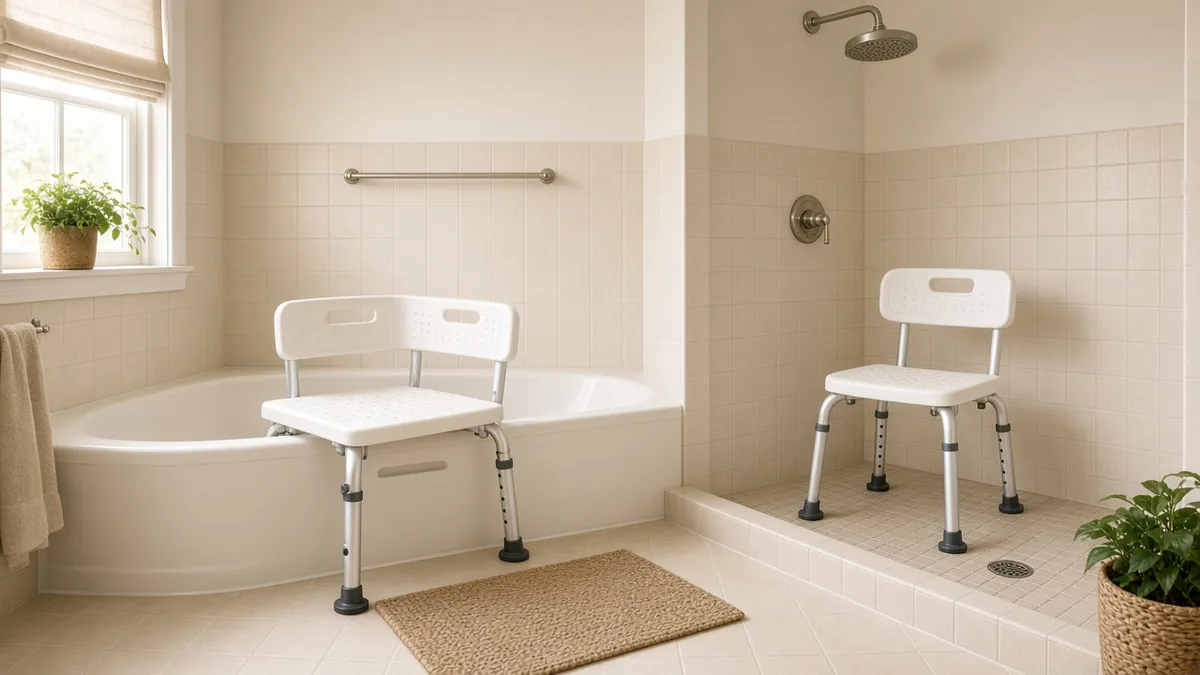
A stool is a small, usually backless seat with four adjustable legs and rubber feet or suction-style tips. A shower chair adds a backrest and often armrests or a cut-out seat. Both live inside the shower or tub. They do not help the person over the side; they only give a place to sit once they are in.
In US shops you will see stools and chairs from Drive Medical (including widely sold padded and blow-moulded chairs), Medline, Invacare, Moen, Lumex, Vive Health and many store brands, including options on shower chair at Amazon US, shower chair at Vive Health and shower chair at MedEquip Shop. In the UK, the same job is filled by shower stools and shower chairs from Days, Homecraft, Drive Devilbiss, Aquatec, CareCo, Complete Care Shop, Healthcare Pro / NRS and chemist or mobility shops. UK catalogues often also list a perching stool, which is a higher, tilted seat used at a basin or kitchen worktop as well as, sometimes, in a shower. A perching stool is not automatically a shower chair — check that the model is rated for wet areas and that the height matches the task.
Before you buy, measure the shower tray or tub floor, the door or curtain opening, and the distance to any glass screen. A chair that fits the floor may still block the door. Check whether the legs can sit flat; a curved tub floor or a steeply sloping tray can make one leg hang, which is how seats tip.
Transfer benches
A transfer bench is longer than a shower chair. Two legs (or a panel) sit inside the tub; two sit outside on the bathroom floor. The seat extends over the tub wall. The person sits down on the dry, outside part, swings or lifts their legs over the side, and slides along to wash. Some benches have a sliding seat; others are a fixed board with a handhold.
US names you will see include Drive Medical, Medline, Moen, Invacare, Lumex, Vive Health and bathtub transfer bench at Amazon US listings, plus medical-supply sites such as transfer bench at MedEquip Shop. In the UK they are usually called bath transfer benches or bath boards (a bath board is a shorter board that sits across the tub rim, which is a different, more limited product). Look at Drive Devilbiss, Homecraft, Days, Aquatec, CareCo, Complete Care Shop and Healthcare Pro / NRS. A bath board can be right when the person can still sit down on the rim and lift their legs in, and a clinician or experienced supplier has confirmed the tub is suitable. It is not the same as a full transfer bench, and it is a poor fit for many modern tubs with curved or very narrow rims.
A comparison you can use in the bathroom
| Shower stool or chair | Transfer bench | |
|---|---|---|
| Sits | Entirely inside the stall or tub | Across the tub wall, inside and outside |
| Helps with stepping over the side? | No | Yes — that is its main job |
| Typical setting | Walk-in shower, or a tub the person can already step into | Bathtub, or a tray so high that stepping in is the risk |
| Caregiver help | Often has to reach into the stall | Can often help from outside while the person sits |
| Space needed | Clear floor inside; door must still close or stay safely open | Clear floor outside the tub as well as inside; watch toilet position and door swing |
| Not for | People whose main problem is the tub wall | A purely walk-in shower with no wall to straddle, unless a therapist has a specific reason |
How to decide, in order
- What is the entry? Walk-in shower with a low or no-step tray: start with a stool or chair. Standard tub with a side wall: start with a transfer bench (or, if a clinician agrees it is suitable, a bath board). High shower tray: treat it more like a tub wall and measure carefully.
- Can the person sit down and stand up from a chair height? Practise this with a sturdy dining chair on a dry, non-slip floor, with a helper close by — not in the shower. If they cannot sit and stand with control, a wet, soapy seat will not fix that. Get clinical advice.
- Do they need a back or arms? Backless stools are lighter and smaller, and they are a poor choice for anyone who leans or who tires mid-shower. Arms can help someone sit and stand; they can also get in the way of a carer’s help or a narrow door. Choose after you watch how the person actually sits down.
- Who is washing whom? If a caregiver needs to wash the person’s back or feet, a transfer bench that leaves the helper outside the tub can be easier on the helper’s back. If the person showers independently in a walk-in stall, a chair with a back may be enough.
- What is the floor doing? Adjustable legs must all touch. Confirm the maker’s weight rating against the person’s current weight, and do not assume a “standard” rating — read the current product page. If you cannot find a capacity, do not buy from the title alone.
Measurement checklist
- Width and depth of the shower tray or tub floor
- Height of the tub wall or tray lip, inside and out (they are not always the same)
- Clear space on the outside of the tub, including the swing of the bathroom door and the position of the toilet
- Width of the shower opening or curtain run — a bench that is wider than the opening will not go in
- Height of the shower controls and the shower head; a seated person still needs to reach, or you need a handheld shower. A handheld shower is often sold separately: handheld shower head at Amazon US, or the equivalent UK listing at handheld shower head at Amazon UK
- Whether glass screens are fixed. Some transfer benches will not fit a tub that has a fixed screen along the long side. A sliding screen or a curtain is usually easier.
If the numbers are tight, take them to a mobility shop or a medical-supply retailer and ask them to confirm fit. In the UK, an occupational therapist can be especially helpful in small bathrooms, which are common in older houses and flats.
Safety points that matter more than the brand name
- Use a shower seat only as the manufacturer describes. Do not stand on a stool to reach a shower head, and do not use a transfer bench as a general bathroom chair outside the tub unless the maker says that is intended.
- Dry foam and soapy surfaces are slippery. Non-slip mats or strips can help, but they must sit flat and be cleaned; a rucked mat is a trip of its own. Follow the mat and seat makers’ instructions.
- Grab bars, if used, should be the right type for the wall. See Grab bars when you cannot drill the tiles for suction and clamp-style options, and their limits. A loose bar plus a loose seat is not a system.
- Set water temperature before the person sits down, and consider a thermostatic valve if scalding is a concern. This article cannot tell you how to set a plumbing valve; use a qualified plumber.
- Keep soap, shampoo and a towel within a seated reach so the person is not twisting off the seat.
- If dizziness, chest pain, sudden weakness or a fall occurs, treat it as a medical problem, not an equipment problem.
A note on bath lifts and walk-in tubs
A powered bath lift (brands such as Drive Devilbiss and Aquatec appear often in the UK, with similar powered seats in some US catalogues) is a different product: it lowers and raises a person inside the tub. A walk-in bathtub is a different renovation again. Neither is a drop-in substitute for a transfer bench, and both have their own weight limits, installation needs and residual slip risk. They are worth discussing with an occupational therapist if a portable bench will not fit or will not be safe, not something to order overnight from a photo.
Bottom line
If the hard part is standing to wash in a space the person can already enter, a shower stool or chair is the tool to consider. If the hard part is the side of the tub, look at a transfer bench and confirm that the screen, the floor and the space outside the tub will actually accept one. Measure the bathroom, read the current weight rating, and get professional advice when transfers are already difficult or there has been a fall. US starting points: shower chair at Amazon US, bathtub transfer bench at Amazon US, shower chair at Vive Health, transfer bench at MedEquip Shop. UK starting points: shower chair at Amazon UK, bath transfer bench at Amazon UK, CareCo, Complete Care Shop and Healthcare Pro / NRS. Confirm every figure on the live page before you buy.