
Disclosure: Lifted At Home is reader-supported. Some links on this page are affiliate links, which means we may earn a commission if you buy through them, at no extra cost to you. See our Affiliate Disclosure.
This article is general information for caregivers. It is not medical advice, and it is not a substitute for an occupational therapist, physiotherapist or doctor. Pain, new weakness, dizziness or a recent surgery can all make dressing unsafe to practise alone. If dressing has suddenly become difficult, or the person feels faint when they bend, get professional advice before you introduce new techniques or aids.
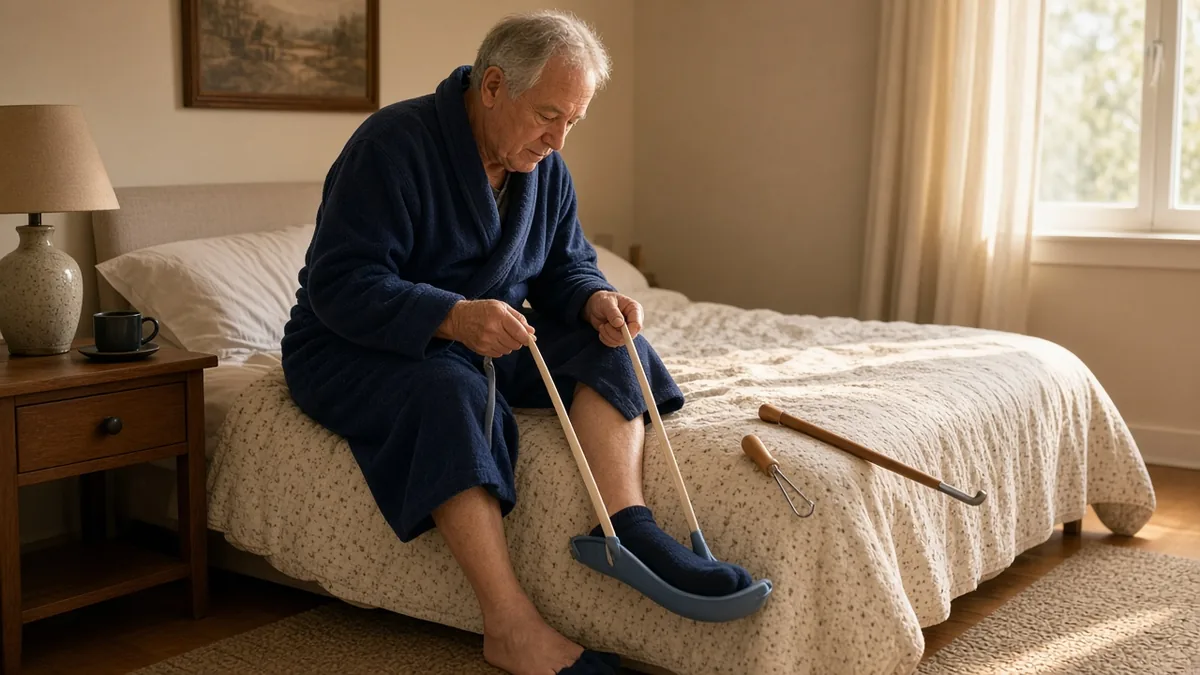
Getting dressed is one of the first daily jobs that quietly becomes a two-person task. Tight socks, a shirt that has to go over a painful shoulder, and buttons on a favourite cardigan can take longer than the rest of the morning. Families often assume the answer is “more help,” when a few small tools — used in the right order, from a seated position — can give some of that independence back. The three that come up most often are a sock aid, a button hook (often combined with a zipper pull), and a dressing stick.
This guide is written from a caregiver’s point of view, for households in the United States and the United Kingdom. It explains what each tool is for, who it tends to help, and how to try it without turning the bedroom into a wrestling match. We have not lab-tested particular models, and we do not invent measurements or “success rates.” Adaptive-clothing brands such as Silverts are mentioned because they reduce the need for some of these tools, not because a piece of clothing is a medical treatment.
The short answer
- A sock aid is for someone who cannot safely reach their feet, or should not bend that far, but can still pull on a pair of ropes or rigid handles once the sock is loaded onto the aid.
- A button hook, often with a zipper pull on the other end, is for hands that can manage a large handle more easily than a small button or a tiny zip tab.
- A dressing stick (a lightweight stick with a hook or push notch at the end) is for getting a shirt or jacket on or off a shoulder, pulling up a trouser waistband, or recovering a shoe — without a full bend or a painful reach.
- If the person cannot sit safely on the edge of the bed or a chair, cannot follow a short sequence, or has been told not to bend or lift a shoulder, start with an occupational therapist, not a shopping basket. Tools work best as part of a method, including sitting down to dress and, sometimes, switching to adaptive clothing.
Start with the method, then add the tool
Most dressing aids assume the person is sitting, with feet on the floor, in a chair that will not roll away, or on the edge of a bed that is not unusually high or soft. Standing on one leg to put on a sock is the habit to retire, whether or not you buy a sock aid.
Work in a warm, well-lit room, with the garments laid out in order. The caregiver’s job on the first few tries is to coach, not to take over at the first pause. If the person becomes breathless, dizzy or frustrated, stop and return to it later. Nothing about a plastic sock aid is urgent enough to rush.
Also look at the clothes themselves. Loose waistbands, front-fastening bras or vests, and fabrics with a little stretch do more than a clever hook. Brands such as Silverts in the North American market make adaptive clothing with magnetic or Velcro closures, open backs, and other features designed for dressing from a seated or lying position: adaptive clothing at Silverts. In the UK, look at specialist adaptive ranges and at easier everyday brands sold through CareCo, Complete Care Shop, Healthcare Pro / NRS and general clothing retailers. A button hook will not make a very tight shirt kind; a different shirt might.
Sock aids
A typical sock aid is a plastic trough or a flexible pouch on two long cords, or a rigid “half-shoe” on a long handle. You stretch the sock over the trough, drop or lower it to the floor, slip the foot in, and pull the cords or handle until the sock comes up the leg and the trough slips out. There are also versions made for compression stockings, which are a different, often harder job and may need a specific aid and clinical advice — ordinary sock aids are frequently not strong enough or not shaped for firm compression garments. If compression wear has been prescribed, ask the person who prescribed it which applicator, if any, they recommend.
US shoppers will see sock aids from Homecraft, Vive Health, Drive, and many unbranded packs on sock aid at Amazon US and sock aid at Vive Health, as well as sock aid at MedEquip Shop. In the UK, Homecraft, Days, and retailer packs from sock aid at Amazon UK, CareCo, Complete Care Shop and Healthcare Pro / NRS are easy to find. Some “deluxe” rigid handles help people who cannot manage floppy cords; some flexible troughs handle thicker socks better. The right one is the one the person can load and pull without twisting off the chair. We do not quote a best model here.
Practical tips from the caregiver side:
- Practise first with a loose sock, not with tight dress socks.
- Make sure the sock is pulled onto the trough evenly, with the heel in the right place if the aid has a heel mark.
- Do not let the person lean sideways off the chair to watch the foot. A mirror on the floor is safer than a bend.
- Terry-cloth or very thick athletic socks can fight a small trough; a slightly larger aid may be needed. Very thin, slippery socks can also refuse to stay on the trough.
- Shoes still have to go on afterwards. A long-handled shoe horn is often the partner tool: long handled shoe horn at Amazon US or long handled shoe horn at Amazon UK.
Button hooks and zipper pulls
A button hook is a small wire loop on a chunky handle. You push the loop through the buttonhole, catch the button, and draw it back through. The other end is often a hook for a zipper tab. For someone with stiff fingers, swollen joints, or a weak pinch, the handle is the whole point: it turns a fingertip job into a whole-hand job.
These are sold widely in both countries as “button hook and zipper pull” combination tools, including Homecraft and similar therapy-supply lines, button hook zipper pull at Amazon US, button hook at Amazon UK, button hook at Vive Health and UK mobility retailers. Some packs include a dressing stick in the same kit, which can be good value if the person needs both, as long as each tool is a decent length and the hooks are not sharp.
They work best on buttons that still fit the hole freely. A very tight, tiny, or fabric-covered button may not come through. If the person dresses in the same two or three cardigans every week, it can be kinder to replace the buttons with slightly larger ones, or to move to magnetic or zip fronts, than to fight the original fastening every morning. A zipper pull does nothing if the zip itself is catching in the fabric; mend or replace that garment.
Dressing sticks
A dressing stick is usually a lightweight wooden or plastic rod with a hook at one end and a rubber push notch or smaller hook at the other. It is used to lift a shirt collar or jacket onto a shoulder, to push a sleeve off, to hook a trouser or skirt waistband, or to pick a shoe up from the floor. People who cannot raise one arm after a shoulder injury, or who should not bend after a hip procedure, are typical users — but only within whatever movement their clinician has already allowed.
Look for a length the person can manage from a seated position without poking the light fitting, and for smooth hooks that will not damage knitwear. US and UK therapy suppliers, dressing stick at Amazon US, dressing stick at Amazon UK, Vive Health, Homecraft, CareCo and Healthcare Pro / NRS all carry them. Some reachers (grabbers) can do part of this job, but a dedicated dressing stick is shaped for clothes rather than for picking up a dropped TV remote. If you already own a reacher, try it before you buy a second stick, and do not use either tool to pull the person themselves up from a chair.
Which tool, in which order
| Difficulty | Tool to try | Also consider |
|---|---|---|
| Cannot reach feet safely to put on socks | Sock aid, seated, loose sock first | Long-handled shoe horn; slip-on shoes; clinician advice if bending is restricted |
| Buttons or zips are fiddly | Button hook and zipper pull | Larger buttons, magnetic or Velcro closures, adaptive tops from brands such as Silverts |
| Cannot raise an arm or reach a sleeve | Dressing stick, or a front-opening garment | Adaptive or open-back clothing; a second person for coats on bad days |
| Several of the above, plus fatigue | A small kit, used seated, with clothes laid out | Simplify the wardrobe; ask an occupational therapist for a dressing assessment |
Safety and dignity
- Dressing should happen in private, at the person’s pace, with the minimum of extra hands. Tools can protect dignity as well as joints.
- If the person has been given movement restrictions after surgery, follow those restrictions even when a tool seems to “make it possible.” A sock aid does not override a clinician’s instructions about bending.
- Watch for loss of balance when they pull on cords. A chair with arms, used on a non-slip floor, is better than the edge of a low, soft bed.
- Do not stand on stools to reach a wardrobe. Bring the clothes to the chair.
- These tools are not pain treatment and they will not strengthen a joint on their own. If dressing pain is new or worsening, treat that as a health issue.
In the US, some dressing aids may be suggested or supplied after an occupational therapy visit; insurance coverage varies and should be checked, not assumed. In the UK, an occupational therapist may be able to advise or, in some cases, provide basic daily-living aids through local services. VAT relief can apply to some qualifying products; ask the seller and follow current HMRC rules.
Bottom line
A sock aid, a button hook and a dressing stick each solve a different, specific snag in the dressing routine. They work best when the person is seated, the clothes are reasonably easy, and no one is in a rush. Try the simple method first, add the tool that matches the actual sticking point, and look at adaptive clothing when fastenings or sleeves are the daily argument. US starting points: sock aid at Amazon US, button hook zipper pull at Amazon US, dressing stick at Amazon US, sock aid at Vive Health, adaptive clothing at Silverts, sock aid at MedEquip Shop. UK starting points: sock aid at Amazon UK, button hook at Amazon UK, dressing stick at Amazon UK, CareCo, Complete Care Shop and Healthcare Pro / NRS. Confirm product details on the live page, and get professional advice if bending, pain or balance is part of the problem.