
Disclosure: Lifted At Home is reader-supported. Some links on this page are affiliate links, which means we may earn a commission if you buy through them, at no extra cost to you. See our Affiliate Disclosure.
This article is general information for caregivers. It is not medical advice, and it is not a substitute for an occupational therapist, physiotherapist, doctor or a qualified installer. If the person you support has a new weakness, pain, or has had a fall, get professional advice before you change how they move around the home.
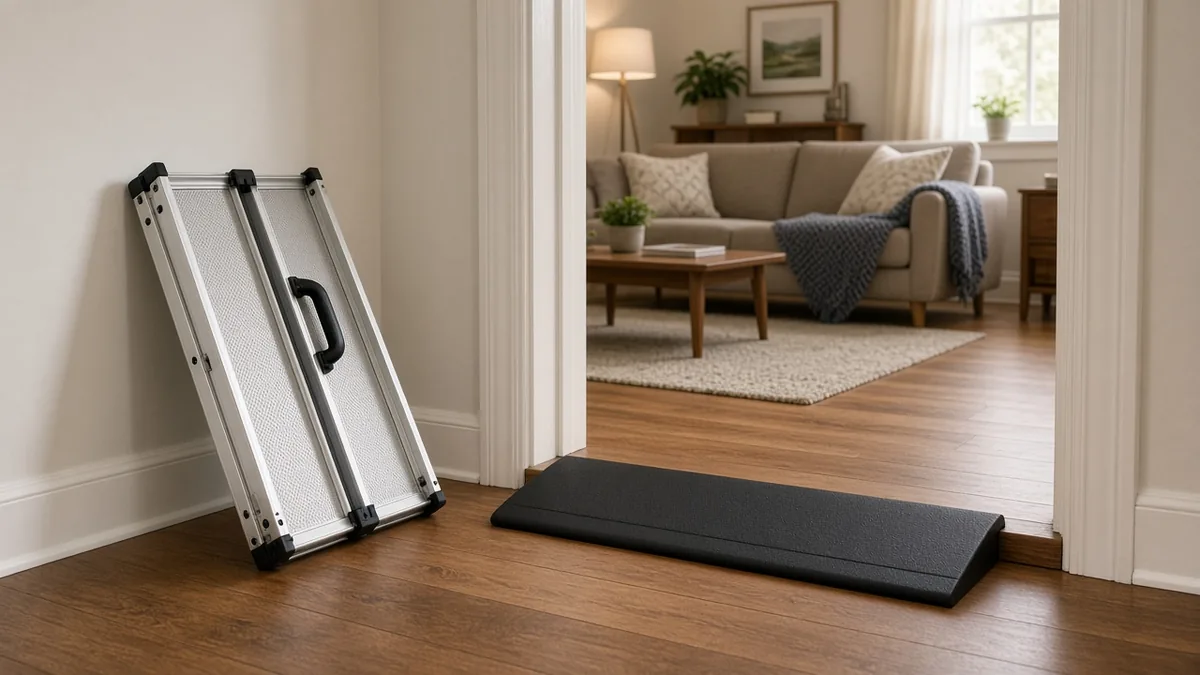
A lot of families buy the wrong ramp because the two common options look similar in a product photo. One is a short wedge that sits over a door sill. The other is a folding portable ramp, often called a suitcase ramp, that is meant to cover a step or two, a curb, or the sill of a van. Using the wrong one is not just a waste of money. A ramp that is too short for the height you have is steeper than it looks in the listing, and that is when wheels catch, walkers skid and people get frightened halfway up.
This guide is written from a caregiver’s point of view. It will help you tell a threshold ramp from a suitcase-style portable ramp, decide which job you actually have in the house, and know when neither of them is the right tool. For how to measure the rise and choose a length, see How to measure a doorway or step for a portable ramp. Product features mentioned below come from the manufacturers’ own pages, checked on 23 November 2026. We have not lab-tested these ramps. Always confirm the current weight rating, length and installation instructions on the maker’s site before you buy.
The short answer
- Use a threshold ramp (sometimes sold as a door sill ramp or threshold plate) when the obstacle is a low door lip, a sliding-door track, or a similar change in level of about an inch or two — not a full step.
- Use a suitcase-style portable ramp (a folding aluminium ramp with a handle) when you need to cover a curb, one step, or sometimes two steps, or to get a wheelchair or scooter in and out of some vehicles. It is carried into place and taken away again.
- If you have three or more steps, a steep front stoop, or someone who will use the entrance every day in a wheelchair, a portable suitcase ramp is often the wrong long-term answer. Look at a longer modular or pathway ramp, a different entrance, or professional advice — and see Portable ramp for two home steps (and when it will not be safe).
What each ramp is actually for
Threshold ramps
A threshold ramp is a short, usually solid wedge or a pair of tapered plates that sit against a door sill. The job is to take the bump out of the doorway so a walker, rollator, wheelchair or scooter does not catch. These ramps stay in place. They are not designed to climb a porch step.
In US catalogues you will often see threshold ramps from EZ-ACCESS (including their Transitions and related threshold lines), Prairie View Industries, and Silver Spring, as well as many store-brand rubber or aluminium wedges sold on threshold wheelchair ramp at Amazon US. In the UK, the same job is filled by threshold ramps and door-sill ramps from Enable Access, Homecraft, Days, CareCo, Complete Care Shop and Healthcare Pro / NRS. Rubber or recycled-plastic thresholds are common for lower lips; aluminium is more typical as the rise gets closer to a very shallow step.
Before you buy, measure the height of the sill at its highest point, the width of the opening, and whether the door still has to swing or slide over the ramp. A threshold that is too tall will jam a door. A threshold that is too narrow will leave a wheel hanging off the edge. The manufacturer’s own rise chart — not the photo — is what you should use.
Suitcase-style portable ramps
A suitcase ramp folds once along its length, has a carrying handle, and is designed to be moved. The best-known US example is the EZ-ACCESS SUITCASE Singlefold Ramp. On EZ-ACCESS’s official product page, checked on 23 November 2026, this ramp is listed in lengths from 2 feet to 8 feet, with a usable width of 30 inches, an 800 lb weight capacity, slip-resistant extruded tread, carrying handles, and self-adjusting bottom transition plates. The same maker also sells a SUITCASE Singlefold AS version (applied, textured surface) that can be separated into two channels, and a SUITCASE TRIFOLD AS ramp that folds again to a shorter packed length. Those differences matter if you need to carry the ramp in a car boot (trunk) or if you want two narrower channels instead of one wide platform. See EZ-ACCESS SUITCASE Singlefold Ramp at Amazon US and the official EZ-ACCESS SUITCASE range.
EZ-ACCESS also publishes usage guidelines on that page (for example, shorter lengths for curbs and one step; longer lengths for more steps or some minivans and SUVs). Those are the maker’s guidelines, not a substitute for measuring your own rise, and the company notes that weights and dimensions are approximate and that you must follow the mobility device’s own slope limits. We do not repeat a length-to-steps rule here as if it were a guarantee for your doorway.
Other US names you will see in the same category include Prairie View Industries portable and suitcase-style ramps, Titan, and various folding ramps sold through medical-supply retailers such as portable wheelchair ramp at MedEquip Shop and folding wheelchair ramp at Vive Health. In the UK, look for folding channel ramps and suitcase-style ramps from Enable Access, The Ramp People, Country Mobility, Days, CareCo and Healthcare Pro / NRS. Channel ramps (two separate tracks) are more common in UK retail than in many US “suitcase” listings. They are lighter to carry but only work if the wheelchair or scooter wheels line up with the channels, which is a poor fit for some walkers and for most people using a rollator.
A simple way to decide
- What are you crossing? If you can hang the toe of your shoe on it and it is clearly a door lip, start with a threshold ramp. If there is a visible step, or you can put a tape measure against a riser of several inches, you need a portable or modular ramp, not a threshold wedge.
- Does it have to move? Threshold ramps stay put. Suitcase ramps are for entrances you cannot permanently alter, visits to other houses, or vehicle access.
- Who and what will go over it? An occupied wheelchair or scooter needs a gentler slope than a rollator used by someone who can still take a little weight through their legs. Add the weight of the person, the device and any bags, and compare that total with the maker’s stated capacity. EZ-ACCESS lists 800 lb for the SUITCASE Singlefold, but other ramps are rated lower — always read the plate or the current spec sheet.
- Will the door still work? A thick threshold can stop a storm door or uPVC door from closing. A suitcase ramp placed in a doorway may need to be removed before the door can shut.
- Is this one entrance the whole problem? If the person is using a wheelchair all day and the only way in is a flight of steps, a folding ramp you set down twice a day is a stopgap. That is a different conversation, involving a longer ramp, a side entrance, or in some houses a stairlift inside rather than a ramp at the front.
Slope, in plain language
Ramp slope is rise over run. The U.S. Access Board’s Guide to the ADA Accessibility Standards (Chapter 4, Ramps and Curb Ramps) describes a maximum running slope of 1:12 for ramps on accessible routes: one inch of rise for every 12 inches of length, which is also 8.33%. The same guide says a gentler slope than the maximum is more usable, and it sets other rules for public accessible routes, including a minimum clear width of 36 inches, a maximum rise of 30 inches per run, and level landings. Official source: https://www.access-board.gov/ada/guides/chapter-4-ramps-and-curb-ramps/
Those ADA figures apply to accessible routes covered by the ADA Standards. They are not a legal checklist for every private home in the United States. They are still the most widely used safety benchmark when a caregiver is choosing a portable ramp, and they are a good reason not to buy a 3-foot ramp for an 8-inch step “because it looks about right.”
In the UK, Approved Document M (Access to and use of buildings) sets maximum gradients for building ramps that depend on the length of the flight. A 1:12 slope is only permitted in some shorter situations; longer ramps are expected to be gentler. For a permanent or building-regulation job, use the current Approved Document M on GOV.UK and a qualified installer or occupational therapist. For a temporary portable ramp at home, still measure the rise and choose a length that keeps the slope as gentle as the space will allow, and follow the ramp and wheelchair makers’ instructions.
A caregiver shorthand that matches 1:12 is: measure the rise in inches, then look for a ramp whose usable length in feet is at least that number (a 6-inch rise wants about 6 feet of ramp for a 1:12 slope). That is a starting point, not a fitting. Some mobility devices require a shallower slope than 1:12 when occupied. EZ-ACCESS says, on the SUITCASE Singlefold page, to refer to the mobility equipment’s owner guide for acceptable ramp usage, including slope and chair direction, and never to exceed those recommendations.
Side-by-side comparison
| Threshold ramp | Suitcase-style portable ramp | |
|---|---|---|
| Typical job | Door sill, sliding-door track, low lip | Curb, one or two steps, some vehicle access |
| Stays in place? | Yes | Usually moved after use |
| Typical materials | Rubber, recycled plastic, aluminium | Aluminium folding platform or channels |
| Door clearance | Must be checked; can block a swinging door | Usually removed so the door can close |
| US brands to look up | EZ-ACCESS Transitions and similar, Prairie View Industries, Silver Spring | EZ-ACCESS SUITCASE (Singlefold, Singlefold AS, TRIFOLD AS), Prairie View, Titan |
| UK brands to look up | Enable Access, Homecraft, Days, CareCo, NRS / Healthcare Pro, Complete Care Shop | Enable Access, The Ramp People, Country Mobility, Days, CareCo, Healthcare Pro / NRS |
| Wrong use | Trying to cover a full porch step | Using a short suitcase ramp on a rise that makes the slope too steep, or as a permanent stair replacement |
What this looks like in a real house
A very common US pattern is a front door with a ¾-inch or 1-inch sill, then two or three concrete steps down to the path. Families sometimes buy one “wheelchair ramp” and hope it will do both jobs. It will not. The sill needs a threshold ramp that stays put; the steps need a much longer portable or modular ramp, or another entrance. If you only fix the sill, the walker still has to be lifted down the steps.
A common UK pattern is a uPVC door with a high threshold, or a patio door with a track, plus a single step out to the garden. A rubber threshold may be enough for the door itself. The garden step is a different measurement. If the person uses a rollator rather than a wheelchair, a full-width suitcase ramp is usually more forgiving than channel ramps, because rollator wheels do not always sit neatly in two tracks.
Vehicle access is a third job again: even a ramp that covers two house steps may be too short or too steep for a higher SUV or boot floor. Follow the vehicle and ramp makers’ guidance, and have two people the first time you try it with a person in the chair.
Safety points caregivers should not skip
- Get help the first time you use a new ramp with a person in a wheelchair or scooter. Practise with the unoccupied device first, on level ground.
- Check that the top of the ramp sits fully on the landing or sill and cannot slip. EZ-ACCESS, for example, describes pre-drilled holes and clevis pins or screws for securing the top of the SUITCASE Singlefold. Other makers have their own methods. Follow the instructions that came with the ramp you actually own.
- Watch wet leaves, frost and polished interiors. “Slip-resistant” is not the same as “safe in all weather.”
- Do not join two suitcase ramps end to end unless the maker says that model can be connected. EZ-ACCESS states that SUITCASE Singlefold ramps cannot be connected; they point customers to other lines if more length is needed.
- If the person is fearful, in pain, or has had a recent fall, stop and get clinical advice rather than coaching them up a steeper ramp “just this once.”
When to get a professional involved
Call an occupational therapist, a reputable ramp supplier who will measure the entrance, or a contractor experienced in accessible work when:
- the rise is more than a couple of steps, or the slope at 1:12 would leave no room for the ramp to land;
- the person will use a wheelchair as their main way in and out;
- you are considering a permanent installation, a change to a listed building, or work that may need a permit or (in the UK) building-regulations advice;
- there is no level landing at the top, or a door swings out over the place the ramp would sit.
In the UK, some households may be able to claim VAT relief on qualifying disability equipment, and some may be eligible for a Disabled Facilities Grant or NHS / local-authority equipment after an occupational therapy assessment. Rules change; check current HMRC and local-authority guidance rather than assuming a purchase is covered. In the US, Medicare and insurance coverage for ramps is limited and depends on the product and on clinical documentation — ask the supplier and the insurer, and do not rely on a product listing alone.
Bottom line
If the problem is a door lip, buy a threshold ramp that matches the measured height and the door’s swing. If the problem is a curb or a step, buy a suitcase-style portable ramp long enough for a gentle slope, and treat the manufacturer’s weight and slope limits as rules, not suggestions. If the problem is a flight of steps, do not force a folding ramp to do a permanent access job. Measure first — the companion article on measuring a doorway or step walks through that in order — and name the entrance you are actually trying to fix before you shop.
US starting points: EZ-ACCESS threshold ramp at Amazon US, EZ-ACCESS SUITCASE Singlefold Ramp at Amazon US, portable wheelchair ramp at MedEquip Shop. UK starting points: folding wheelchair ramp at Amazon UK, Enable Access, CareCo, Complete Care Shop and Healthcare Pro / NRS threshold and folding ramps. Confirm every figure on the live product page before you order.