
Disclosure: Lifted At Home is reader-supported. Some links on this page are affiliate links, which means we may earn a commission if you buy through them, at no extra cost to you. See our Affiliate Disclosure.
This article is general information for caregivers. It is not medical advice, and it is not a substitute for an occupational therapist, physiotherapist, doctor or a qualified installer. Two steps can still be a serious fall risk. If the person you support has a new weakness, pain, or has had a fall, get professional advice before you change how they enter the house.
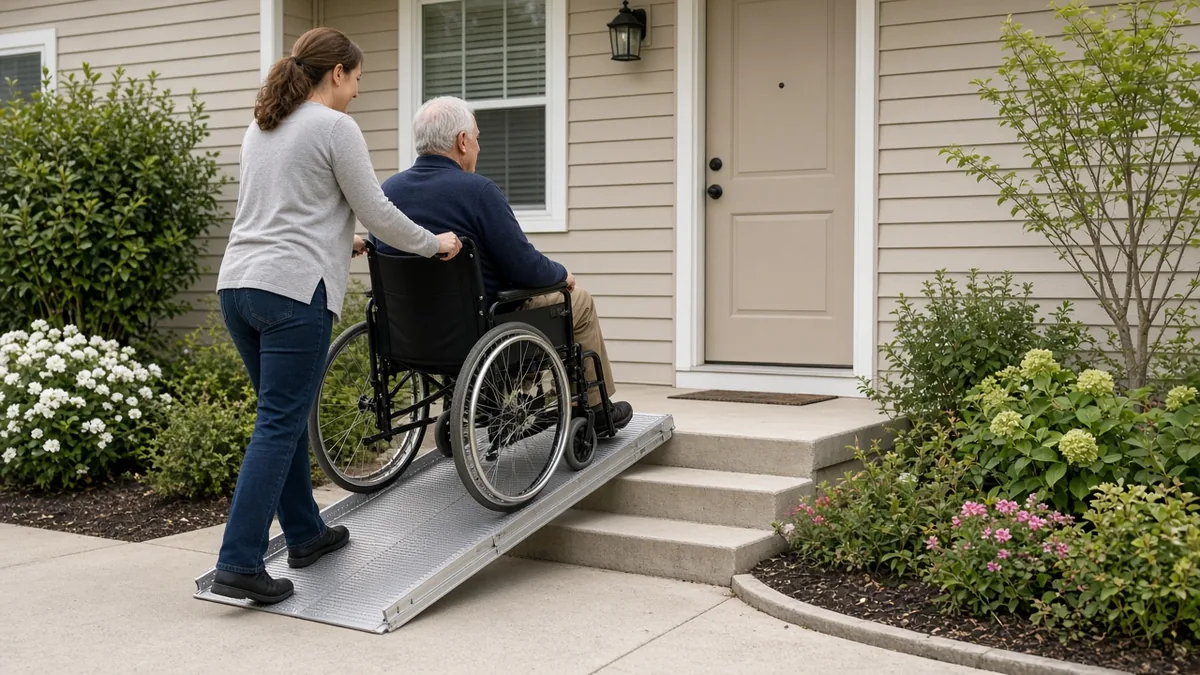
Two steps look manageable. They are the kind of entrance a family often tries to solve with a folding “suitcase” ramp bought online, especially after a hospital discharge when everyone wants the person home this week. Sometimes that works. Often it does not, because two ordinary house steps are higher than they look, and a short portable ramp over that height becomes a steep aluminium hill.
This guide is for caregivers deciding whether a portable ramp is a honest solution for a two-step entrance, or whether you should use another door, a longer modular ramp, or professional help. Measure first using How to measure a doorway or step for a portable ramp. If you are still choosing between a door-sill wedge and a folding ramp, start with Threshold ramp vs suitcase ramp.
Start with the rise, not the number of steps
“Two steps” is not a measurement. Two shallow internal steps can be a very different height from two brick risers up to a US front stoop or a UK Victorian door. Measure the total vertical rise from the lower ground to the finished floor or porch landing, at more than one point across the width, and write down the largest figure.
Until you have that number, ignore product titles that say a ramp is “for two steps.” Those phrases are marketing shorthand. Makers who are careful, including EZ-ACCESS on the official SUITCASE Singlefold page (checked on 23 November 2026), publish usage guidelines by length and still tell you to follow the mobility device’s own slope limits. Treat those guidelines as a starting point for your measured rise, not as a guarantee for your house.
What a safe slope looks like here
The U.S. Access Board’s Guide to the ADA Accessibility Standards (Chapter 4) describes a maximum running slope of 1:12 for ramps on accessible routes, a minimum clear width of 36 inches, a maximum rise of 30 inches in a single run, and level landings. Official source: https://www.access-board.gov/ada/guides/chapter-4-ramps-and-curb-ramps/. Those rules apply to accessible routes covered by the ADA Standards. They do not automatically govern every private home, but they are the benchmark you should use if you are shopping without an installer.
For a caregiver, 1:12 means the usable length of the ramp, in feet, should be at least the rise in inches. If two steps add up to 14 inches of rise, a 1:12 target is about 14 feet of ramp. A 6-foot suitcase ramp on a 14-inch rise is roughly 1:5, which is much steeper than the ADA maximum. That is the kind of setup where a wheelchair helper strains, a scooter underbody can catch, and a person with a rollator feels as if they are walking down a well-polished slide.
In the UK, Approved Document M sets maximum gradients that vary with the length of the flight; 1:12 is only acceptable in some shorter situations, and longer building ramps are expected to be shallower. For a permanent installation, use the current Approved Document M on GOV.UK and a qualified professional. For a temporary portable ramp, still choose the longest ramp the site will allow, and do not talk yourself into a short, steep foldaway because it is easier to store.
The ADA 30-inch maximum rise per run is also worth sitting with. Many two-step house entrances are under that height; some high stoops are not, and even when the rise is under 30 inches, you still need landings and a slope you can actually use. A portable ramp does not create a landing that is not there.
When a portable ramp can be a reasonable short-term answer
A folding portable ramp is more likely to be appropriate when all of the following are true:
- You have measured the rise and you can fit a ramp long enough for a gentle slope (aiming at 1:12 or shallower, unless a clinician or the device maker requires better).
- There is a reasonably level, firm place at the top and the bottom, not a cambered road edge or a flower bed.
- The door can still be used — it does not swing out into the only place the ramp can sit, or you can remove the ramp after each use and have a plan for that.
- The combined weight of the person, the device and typical bags is within the ramp’s published capacity. The official EZ-ACCESS SUITCASE Singlefold listing, for example, states an 800 lb capacity; other models differ. Check the live spec.
- Someone able-bodied can place, secure and store the ramp every time it is needed, following the maker’s fixing method (some ramps use pins or screws at the top; EZ-ACCESS describes clevis pins or screws on the SUITCASE Singlefold).
- You have practised with the unoccupied chair or walker first, then with a second person present when someone is on the ramp.
This is often the situation for a temporary return from hospital, for visiting another house, or for a side door with a modest rise and a long, straight path. It is not automatically the situation for the front steps of the house just because they happen to number two.
When a portable ramp is the wrong answer
Do not force a suitcase ramp onto two steps if:
- The length required for a sensible slope will stick out into a pavement, a parking space, a neighbour’s deeded area, or a steep drive.
- There is no level landing at the top, so the person would arrive at a door they have to hold open while still on the slope.
- The user will go in and out many times a day in a wheelchair, and you would be folding and unfolding a heavy ramp each time. Official EZ-ACCESS figures list approximate weights that rise with length (the SUITCASE Singlefold page, checked on 23 November 2026, lists from 11 lbs at 2 feet to 47 lbs at 8 feet). An 8-foot ramp is already a lot for one person to carry daily; a still longer ramp may not be a “portable” job at all.
- You are tempted to join two short ramps end to end. Some makers forbid this on particular models. EZ-ACCESS states that SUITCASE Singlefold ramps cannot be connected to each other.
- The only devices in the house are rollators or walking frames, and someone has suggested channel ramps (two separate tracks). Channels can leave a rollator with no safe surface under its frame.
- The person is frightened, visually impaired, has a new weakness on one side, or has already fallen on those steps. A piece of equipment will not by itself undo a clinical risk. Get advice.
- The entrance is the only way out in a fire and the ramp would be stored in a shed. An access plan has to work on a bad day, not only when everyone is home and the ramp is already in place.
A practical check you can do this afternoon
- Measure total rise and available run, as in the measuring article.
- Write the 1:12 target length next to the available run. If the target is longer than the space, stop. Look at another entrance before you browse ramps.
- Photograph the door swing, the landing, and the bottom of the steps.
- Weigh or look up the device; add the person’s weight.
- If a portable ramp still looks possible, compare full-width folding ramps (often easier for mixed use) with modular or pathway ramps that stay in place. Brands to look up in the US include EZ-ACCESS (SUITCASE and also their GATEWAY / modular lines when a portable ramp is too short or you need handrails — EZ-ACCESS notes the SUITCASE Singlefold does not include handrails and points to GATEWAY 3G when handrails are needed), Prairie View Industries and similar makers. In the UK, look at Enable Access, The Ramp People, Country Mobility, and retailers such as CareCo, Complete Care Shop and Healthcare Pro / NRS. Confirm every length, width and capacity on the maker’s current page.
- The first use with a person on the device should not be in the rain, in the dark, or when you are in a hurry to get to an appointment.
Handrails, edges and helpers
A portable suitcase ramp often has no handrail. That is a design choice, not a defect, but it matters. Someone using a rollator cannot hold a rail that is not there, and a helper cannot steady a chair as easily on a narrow, rail-less slope. If the person needs a rail, you are usually looking at a different product family or a semi-permanent installation, not a longer version of the same folding ramp.
Watch the sides. A wide platform is more forgiving than two channels. Keep feet, oxygen tubing and bag straps inside the surface. Helpers should walk in a way that does not pull the chair sideways off the edge. If two people cannot comfortably help, the ramp is too narrow or the slope is too steep for that situation.
Other ways into the same house
Before you spend money, walk the property once more:
- A back or garage door with a lower rise and a straighter path is often the better “front door” from now on.
- A threshold ramp may still be needed at the door itself even after you solve the steps, so you may be buying two different products, not one.
- Inside the house, if the real problem is the stairs to the bedroom, a front-door ramp will not help. That is a stair-rail or stairlift conversation (in the US, Acorn is one widely advertised option; in the UK, Acorn and other local suppliers). A stairlift and a door ramp solve different problems.
- In the UK, an occupational therapist can sometimes be the route to local-authority equipment or a Disabled Facilities Grant. VAT relief on qualifying disability products is a separate set of current HMRC rules — ask the seller; do not assume. In the US, permits may apply to a permanent outdoor ramp, and Medicare coverage for ramps is limited; ask the insurer and the supplier in writing.
Bottom line
Two home steps are only a portable-ramp job if the measured rise, the available length, the landing, the door swing and the user’s situation all line up. “It is only two steps” is not a reason to buy a short suitcase ramp. Measure, aim for a gentle slope, and be willing to say that this entrance needs a longer, staying-in-place ramp or a different door. Shopping starting points, once the numbers support a portable ramp: EZ-ACCESS SUITCASE Singlefold Ramp at Amazon US, portable wheelchair ramp at Amazon US, portable wheelchair ramp at MedEquip Shop, folding wheelchair ramp at Amazon UK, plus UK specialists such as Enable Access and retailers including CareCo and Healthcare Pro / NRS. Confirm specifications on the live product page, and get professional advice if the slope or the landing is not clearly adequate.